
Table of Contents
When choosing between full coverage vs. basic coverage auto insurance, most drivers know the terms but freeze when it’s time to actually decide. The difference isn’t just a marketing label. It determines whether you walk away from an accident with a repaired car or a bill you weren’t expecting. This article breaks down exactly what each option covers, what the real cost gap looks like in 2026, and gives you a concrete formula to figure out which one fits your specific vehicle and budget.

For drivers in Florida, where weather events and elevated claim rates push premiums higher than most of the country, getting this decision wrong in either direction is expensive. DalcavaCorp, based in Miami, helps Spanish-speaking families work through this exact choice with clear numbers and straightforward guidance.
What “Full Coverage” Actually Includes
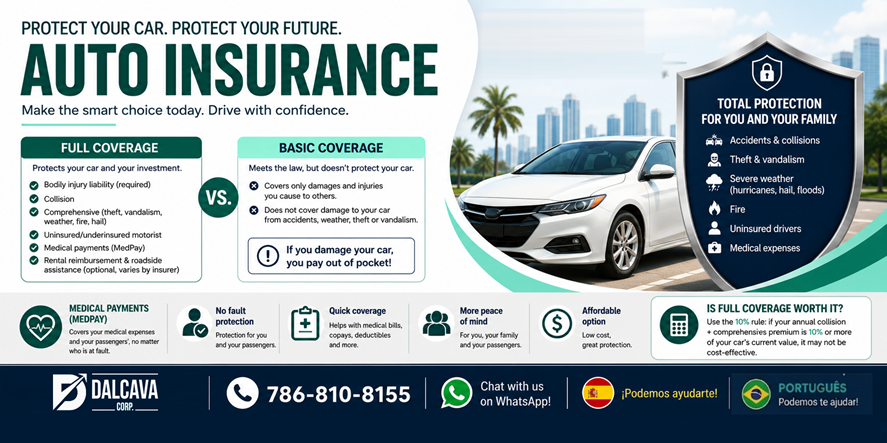
“Full coverage” is not an official insurance term. No policy document uses it as a formal category, and no two insurers define it identically. What people mean by full coverage is a bundle that starts with your state-required liability, then layers on collision, comprehensive, and usually uninsured/underinsured motorist protection (UM/UIM) along with medical payments coverage (MedPay).
Each piece has a distinct job. Collision coverage pays to repair or replace your car after a crash with another vehicle or a fixed object, regardless of who caused the accident. Comprehensive coverage handles everything else: theft, vandalism, fire, hail, flooding, and animal strikes. UM/UIM steps in when the other driver has no insurance or not enough of it. MedPay covers your own medical expenses and those of your passengers after a crash, independent of fault.
Consider a real-world scenario. A hailstorm tears through a Miami parking lot and dents your hood, that’s a comprehensive claim. Two days later, you rear-end someone at a red light, that’s a collision claim. Both scenarios fall under full coverage. Neither is covered under basic liability alone.
Because “full coverage” is informal shorthand, the exact bundle varies by insurer. One policy may include rental reimbursement and roadside assistance; another may not. Before assuming what’s in your quote, read the actual coverage sheet. The label matters less than the line items.
Full Coverage vs. Basic Coverage Auto Insurance: What Each Covers
Liability-only coverage pays for the other driver’s property damage and bodily injuries when you cause an accident. It fulfills your state’s legal minimum and protects you from owing the other party out of pocket. Liability breaks into two parts: bodily injury liability, which covers medical costs and lost wages for people you injure, and property damage liability, which covers their vehicle and any other property you damage.
Suppose you run a red light and hit another car. The driver suffers a broken arm and their car needs $8,000 in repairs. Your liability coverage pays those costs up to your policy limits. Without it, those bills come directly out of your pocket and could follow you into a lawsuit.
The gap that catches many drivers off guard: liability covers the other person’s losses, not yours. If you total your own car in that same crash, basic coverage pays nothing toward your vehicle. The same applies if a hailstorm destroys your car, an uninsured driver rear-ends you at a stoplight, or your car is stolen from your driveway. You absorb every dollar of that loss yourself. That exposure is precisely what full coverage is designed to eliminate.
The Real Cost Difference Between the Two Options in 2026
According to Insurance.com’s national average for car insurance, the national average for full coverage in 2026 runs between $2,578 and $2,697 per year. State minimum liability-only coverage averages between $738 and $820 per year. That puts the typical annual gap at roughly $1,840 to $1,877, or about $150 to $155 per month more for full coverage.
How Age Affects the Full Coverage vs. Liability Gap
For young drivers, that gap widens significantly. A 16-year-old pays an average of $2,443 per year for liability-only but $8,013 for full coverage, a difference of $5,570 annually. By age 22, the same gap narrows to around $2,275. By age 65, it shrinks further to roughly $1,439. Risk profile drives the spread, and young drivers carry the steepest collision and comprehensive premiums.
How Your Deductible Choice Moves the Premium
Your deductible also moves the number. Bankrate’s data on how deductibles affect insurance shows that a full coverage policy with $500/$500 deductibles (collision/comprehensive) costs approximately $2,638 per year. Raising both to $1,000 drops the annual premium to around $2,336, saving about $302 per year. The deductible applies per claim, not annually, so filing two claims in a single year means paying the deductible twice. That trade-off matters most for drivers in areas with high claim frequency, such as regions prone to severe weather, including parts of Florida.
When Full Coverage Isn’t Optional: Lenders and Leased Vehicles
If your vehicle is financed or leased, the lender holds a financial interest in that car until the loan is paid off. To protect that interest, virtually every lender requires both collision and comprehensive coverage as a condition of the loan agreement. They also require themselves to be listed as the loss payee on the policy, meaning any insurance payout goes to them first.
Most lenders also impose a deductible cap, commonly $500 or $1,000, to ensure the coverage remains meaningful. If you drop to liability-only on a financed vehicle, you violate the loan contract. The lender can then place force-placed insurance on your account, which is typically far more expensive than what you would have paid voluntarily and covers only their interest, not yours. For a clear summary of typical lender requirements, see Progressive’s guidance on financed-car insurance requirements.
State law and lender requirements are separate rules from separate sources. Florida law requires you to carry liability coverage; your lender requires collision and comprehensive on top of that. Once the car is paid off, the lender requirement disappears. At that point, the coverage decision becomes entirely yours, based on the vehicle’s value and your own financial situation. That’s often the first real opportunity to weigh liability vs. full coverage on its financial merits alone.
How to Decide Whether Full Coverage Is Worth It on Your Car
Using the 10% Rule to Compare Full Coverage vs. Basic Coverage
A practical starting formula: divide your annual collision and comprehensive premium by your car’s current actual cash value (ACV). If that number is 0.10 or higher, meaning the premium equals 10% or more of the vehicle’s value, full coverage is often not cost-effective. This is the 10% rule, and it works as a reasonable first filter when weighing full coverage vs. basic coverage auto insurance options.
Then factor in the deductible. Your realistic payout if the car is totaled isn’t the full vehicle value; it’s the vehicle value minus your deductible. A car worth $3,000 with a $1,000 deductible only nets $2,000 in a worst-case total-loss claim. If you’re paying $400 per year in collision and comprehensive premiums on that vehicle, you’d recover those premiums in roughly five claim-free years. That math works against keeping the coverage.
Here’s a worked example. Your car’s current market value is $6,000. Your annual collision and comprehensive premium is $700. Divide $700 by $6,000: the result is 0.117, or about 11.7%. That exceeds the 10% threshold, which points toward dropping the coverage. Your net payout if totaled, with a $1,000 deductible, would be $5,000. You’d pay $700 per year to protect a maximum recovery of $5,000.
When to Drop Full Coverage: Two Quick Checks
Before acting on the 10% rule alone, run two quick checks:
- Does the car still carry a loan or lease? If yes, keep full coverage regardless of the math. The lender requires it.
- Could you absorb the total loss out of pocket without serious financial strain? If yes, and the 10% threshold is exceeded, dropping collision and comprehensive is a defensible financial choice.
One important Florida-specific note: comprehensive claims run higher in the state because of hurricane season, frequent hailstorms, and flooding risk, all well-documented factors that drive elevated insurance losses in Florida compared to most other states. Even on an older vehicle where the math tilts toward dropping coverage, keeping comprehensive alone (without collision) can make sense here. With many insurers, comprehensive premiums are often lower than collision, though this varies by carrier and region, and the weather exposure in Florida is genuinely elevated. For a more detailed local perspective, review our Florida car insurance guide.
Making the Right Call on Full Coverage vs. Basic Coverage Auto Insurance
The core decision comes down to this. Full coverage protects your own vehicle against crashes, weather damage, theft, and more. Basic liability protects you legally against the other driver’s losses but leaves your car entirely unprotected. The national cost gap runs close to $1,877 per year, but the right answer depends entirely on what your vehicle is worth, what you still owe on it, and what you can realistically replace out of pocket.
Start with the 10% rule: if the annual collision and comprehensive premium equals 10% or more of the car’s actual cash value, the coverage often isn’t financially efficient. Check whether a lender requires it. Then adjust your deductible to fine-tune the premium in either direction. Those three steps handle the majority of cases. For guidance on when to drop collision and comprehensive coverage, MoneyGeek provides a useful checklist that aligns well with the 10% rule.
DEJA TU COMENTARIO