
Table of Contents
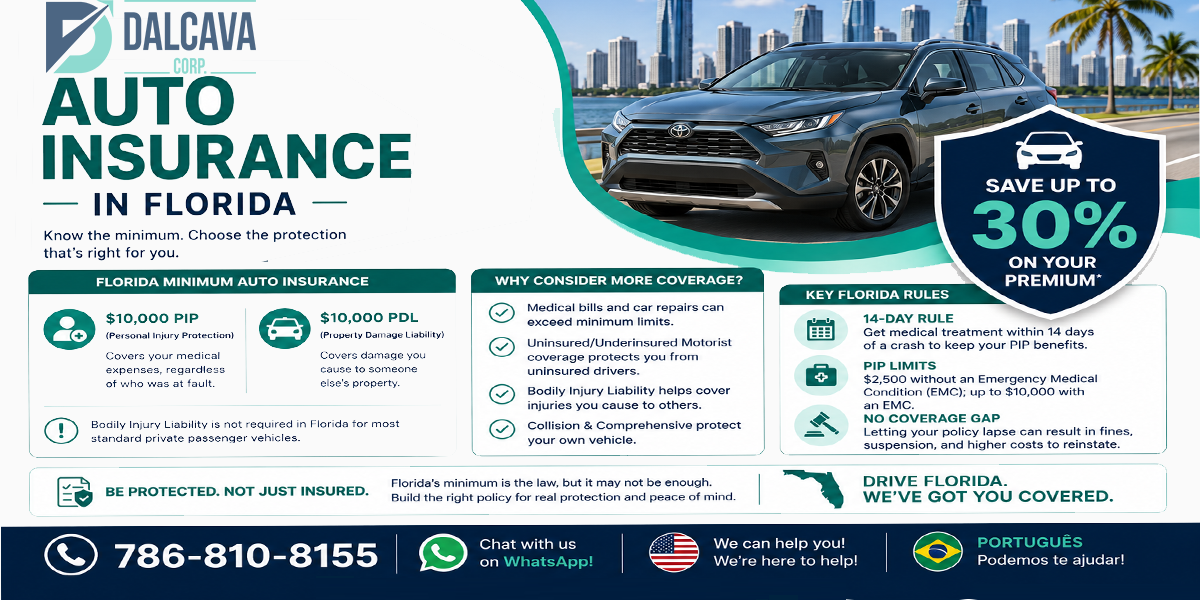
If you’ve ever wondered what minimum auto insurance coverage does Florida require, here’s the short answer: $10,000 in Personal Injury Protection (PIP) and $10,000 in Property Damage Liability (PDL) for every registered four-wheeled vehicle in the state. But knowing the numbers is only half the story.

Picture this: you’re driving on I-95 near Miami when a car clips your bumper at a red light. Everyone gets out, you exchange information, and then the other driver asks which insurance company you use. You pull up your insurance card on your phone and realize you aren’t completely sure what your policy actually covers. You know you have “the minimum,” but you don’t actually know what that means in Florida.
What minimum auto insurance coverage does Florida require: the two mandated policies
Florida requires all registered four-wheeled vehicles to carry both PIP and PDL. That’s the core answer to what the state’s required auto insurance in Florida actually looks like. What surprises a lot of drivers is that bodily injury liability (BIL) is not required for most standard private passenger vehicles. In virtually every other state, liability coverage for injuries you cause to others is the centerpiece of a minimum policy. Florida’s no-fault design flips that logic: since your own PIP pays your initial medical costs, the state made PIP mandatory and left bodily injury liability optional for most drivers.
Personal Injury Protection: Florida’s no-fault layer
PIP pays your own medical costs after a crash, regardless of who caused it. Under Florida law, the $10,000 limit is tied to the named insured as a person rather than strictly to the vehicle, which means PIP can extend to cover you as a driver, eligible household family members, passengers who don’t carry their own PIP, and pedestrians struck by your vehicle, though the exact scope depends on your policy language and the Florida PIP statute.
Because PIP pays first and asks fault questions later, it provides fast access to medical benefits after a crash. The tradeoff is that it has real limits, both in the dollar amount and in how it calculates payments, which the next section covers in detail.
Property Damage Liability: protecting what you damage
PDL is entirely separate from PIP. It pays for damage you cause to someone else’s property, most commonly their vehicle, but also fences, structures, or other objects you hit. One critical point: PDL does not cover damage to your own vehicle. That’s a common misconception that leaves drivers unpleasantly surprised after a crash. The $10,000 Florida PDL minimum is the legal floor, but a single rear-end collision involving a newer vehicle can easily push past that number.
How PIP actually works after a crash
Many drivers assume PIP means their full medical bill is covered up to $10,000. The reality is more nuanced, and understanding it before you need to file a claim saves a lot of frustration.
The 80/60 payment rule and the 14-day deadline
PIP pays 80% of reasonable medical expenses and 60% of lost wages, not 100%. If you earn $1,000 per week and miss two weeks of work, PIP covers $1,200 of that $2,000 loss. The remaining 20% of medical bills and 40% of lost wages fall to you unless you have additional coverage. PIP also includes a $5,000 death benefit.
The most important rule many drivers don’t know: you must receive initial medical treatment within 14 days of the crash. Miss that window and you lose your PIP medical benefits entirely, regardless of how serious your injuries are. The claim doesn’t have to be filed within 14 days, but you must be physically seen by a qualifying provider during that period.
The $2,500 cap and the Emergency Medical Condition threshold
Florida law limits PIP medical benefits to $2,500 unless a licensed provider diagnoses an Emergency Medical Condition (EMC). An EMC is a condition with acute symptoms severe enough that, without immediate medical attention, it could seriously jeopardize your health or cause serious impairment of bodily function. If your treating doctor confirms an EMC, the full $10,000 becomes available. If no EMC is diagnosed, you’re capped at $2,500 in medical benefits, even if your bills are much higher.
Per the Florida PIP statute, PIP also excludes pain and suffering, massage therapy, non-economic losses, and any care received outside the 14-day treatment window. Knowing these limits before a crash helps you make smarter decisions about the coverage you add to your policy.
What happens when your Florida coverage lapses
Florida tracks insurance coverage through its electronic database, and gaps get noticed. If your policy lapses, even briefly, the consequences are immediate and structured.
The fine schedule and what gets suspended
Under Florida’s reinstatement fee schedule, a first lapse triggers a $150 fee. A second lapse within three years costs $250. A third offense within three years brings a $500 fee. Beyond the fees, Florida can suspend your driver’s license, license plate, and vehicle registration for up to three years. Because fees and fines can stack, a pattern of lapses becomes expensive quickly, and that’s before factoring in the higher premiums that often follow a coverage gap.
Registration consequences and how to get reinstated
Florida requires proof of insurance to register or renew your vehicle registration. If coverage lapses, the state can refuse registration renewal or require you to surrender your plates until coverage is restored. Reinstatement means restoring your coverage, paying the applicable fee, and filing the required documentation with the Florida Department of Highway Safety and Motor Vehicles (DHSMV). The simplest and cheapest approach, by a wide margin, is maintaining continuous coverage so you never enter this process at all.
Situations where the standard rules don’t apply
Not every Florida driver and vehicle falls under the same $10,000/$10,000 framework. Several specific groups face different requirements.
Motorcycles, rideshare drivers, and out-of-state residents
Motorcycles are exempt from PIP entirely. However, riders who want to operate without a helmet must carry at least $10,000 in medical benefits coverage. Rideshare drivers face higher thresholds when their app is active: $50,000 per person and $100,000 per accident in bodily injury coverage, plus $25,000 in PDL while waiting for a ride request. Once a passenger is on board, the Transportation Network Company must provide $1 million in liability coverage.
Out-of-state residents who keep a vehicle in Florida for more than 90 days in any 365-day period, even if those days are non-consecutive, must register the vehicle in Florida and carry the state minimums. This catches many people off guard, particularly those who split time between Florida and another state.
SR-22 and FR-44: proof of financial responsibility for high-risk drivers
SR-22 is required for drivers whose licenses have been suspended for reasons like driving without insurance or accumulating serious traffic violations. It is a certificate filed by your insurer with the DHSMV confirming you carry at least the Florida minimum auto insurance. It is typically required for three years from the date of license reinstatement, not from the conviction date.
FR-44 is specifically for DUI convictions and requires significantly higher limits: $100,000 per person and $300,000 per accident for bodily injury, plus $50,000 for property damage. Those are substantially higher than standard minimums, and they make FR-44 policies considerably more expensive. For both filings, a coverage lapse during the required period triggers an immediate license suspension, and in some cases, the three-year clock resets.
Why Florida’s minimums often aren’t enough
Meeting the legal minimum and being genuinely protected are two different things. Florida’s minimums were designed as a floor, a starting point that satisfies the law but doesn’t account for the real costs of a serious crash. Most drivers who rely solely on the state minimum discover its limits only when they’re in the middle of a claim.
Where $10,000 runs out fast
Consider a straightforward two-car crash where the other driver’s vehicle sustains $18,000 in damage. Your $10,000 PDL pays its limit, and you’re personally responsible for the remaining $8,000. On the medical side, an emergency room visit with follow-up imaging can plausibly exceed $10,000 in Florida’s healthcare market, meaning your entire PIP benefit could be consumed by a single incident before any follow-up care begins. When PIP runs out, the injured party may pursue you personally if you were at fault and your PDL is already exhausted.
Coverages worth adding to a Florida policy
Several additions make a meaningful difference without dramatically raising your premium. Bodily Injury Liability (BIL) pays for injuries you cause to others. It’s not required for most Florida drivers, but it’s one of the most important protections you can add, accident costs routinely exceed what PIP covers.
Uninsured Motorist (UM/UIM) coverage is especially worth considering in Florida, where a significant share of drivers carry no insurance at all (the Insurance Research Council has reported uninsured rates in Florida among the highest in the nation). Collision and comprehensive coverage protect your own vehicle, which neither PIP nor PDL addresses. Higher PIP limits or a medical payments rider can also reduce your out-of-pocket exposure after a crash.
Getting the right Florida auto coverage without overpaying
Understanding what Florida’s required auto insurance covers is the first step. Turning that knowledge into a policy that delivers genuine protection at a price that fits your budget is where a knowledgeable agent earns their value. In a state where the minimum coverage leaves real gaps, the difference between being insured and being protected often comes down to having the right conversation before you buy.
Questions to ask before you buy a policy
Before signing anything, ask your agent these specific questions:
- Does this policy meet Florida’s PIP and PDL minimums?
- What is the EMC threshold on my PIP, and what happens if no EMC is diagnosed?
- Does my PDL limit realistically cover vehicles in my area?
- Am I covered if the other driver carries no insurance?
- What is the reinstatement process if I ever miss a payment?
A good agent answers all of these clearly, without hesitation. If the answers are vague, that’s a signal to keep looking.
DEJA TU COMENTARIO