
Table of Contents
A crash happens fast. One moment you’re driving. The next, your hands are shaking, cars are stopped at odd angles, and your mind goes blank. Many drivers have never rehearsed their post-accident actions, and that gap costs them: in safety decisions made in the first minutes, in insurance claims handled poorly, and sometimes in legal rights that expire before they even knew the clock was ticking.

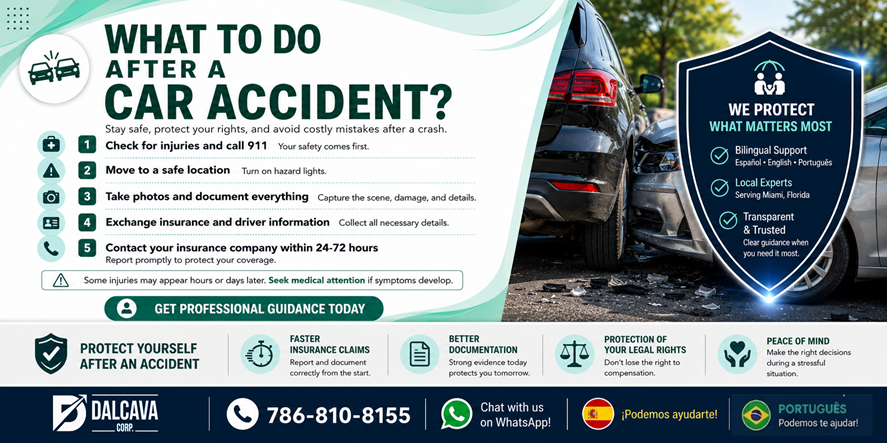
If you’re wondering what to do after a car accident, this guide covers 12 specific steps organized by when they happen: what to do at the scene, what to document before you leave, when to call your insurer, which injury symptoms to watch for in the days that follow, and when to get an attorney involved. Bookmark this page or save it to your phone now, before you ever need it.
What to Do After a Car Accident: Your First Four Moves
These steps happen in the first moments after impact. They protect lives and keep you legally protected at the same time. Get them right, and everything that follows becomes easier.
Steps 1-2: Stop the car and check for injuries
Never leave the scene. Duty-to-stop laws apply across the United States, and leaving, even briefly, can turn a civil matter into a criminal one. Check yourself, your passengers, and anyone in the other vehicle for visible injuries, and call 911 immediately if anyone appears hurt, even if the injury looks minor.
Adrenaline is a powerful pain mask. You or someone else may feel fine at impact and discover a serious injury an hour later. When in doubt, call 911 and let trained responders make that call for you.
Steps 3-4: Call 911 and move to a safer position
In many states, calling police is required when there are injuries, fatalities, or significant property damage, and even for a minor fender-bender, an official report creates a record that protects you when the other driver’s story changes later. Check your state’s reporting threshold, but when in doubt, make the call. If the vehicles are drivable, move them to the shoulder or a nearby parking lot to clear traffic, but stay at the scene. Turn hazard lights on immediately to warn other drivers and prevent a second collision.
When speaking to officers, stick to the facts. Do not apologize, speculate about fault, or explain what you think happened. Casual statements made at the scene can become problems during the insurance process. Report what you observed; let the investigation sort out everything else.
What to Do After a Car Accident, Document the Scene
This is the documentation phase: steps 5 through 7, and your after a car accident checklist for evidence. Good documentation gathered at the scene is worth more than any statement made afterward. Take your time here if the situation allows. For a step-by-step walkthrough on photographing and preserving evidence at the crash site, see how to properly and effectively document an accident scene.
Step 5: What to photograph and how to do it right
Shoot the full scene from multiple angles: all vehicles, their positions relative to each other, and every license plate. Capture road conditions including skid marks, debris, broken glass, traffic signs, and any construction zones. Photograph visible injuries on yourself or others if it is safe and appropriate to do so.
Back up your photos immediately to cloud storage or a second device. If your phone is damaged in a follow-up incident or lost during a tow, those images are gone. Upload first, then keep shooting.
Steps 6-7: Exchanging information and getting the police report number
Collect the following from every driver involved: full name, phone number, address, driver’s license number, license plate number, and the name and policy number of their insurance company. Get the responding officer’s name, badge number, and the incident report number. Ask specifically where and how you can obtain a copy of the report.
If police do not come to the scene, which happens in minor crashes, file a report yourself at the local station or through your state’s DMV portal. In Florida, if there is property damage, injury, or death and no law enforcement crash report was made, you must submit a written report to the Florida Department of Highway Safety and Motor Vehicles within 10 days. Before leaving the scene, also collect contact information from any witnesses. They will be harder to find later.
The two calls you need to make within 24 to 72 hours
Drivers often wait too long to contact their insurer after a collision. That delay can complicate coverage and, in some cases, give the carrier grounds to reduce or deny your claim entirely.
Step 8: Notifying your insurance company
Contact your insurer the same day or within 24 to 72 hours, even if fault has not been determined yet. State rules and carrier expectations vary, learn more about when to report a car accident to your insurance company. When you call, have ready: the date, time, and location of the crash; driver details from both vehicles; a summary of the damage; the police report number; and any witness information you collected. You do not need a complete picture to open the claim. If you’re unsure how to proceed, review guidance on how to file an insurance claim. Report promptly and let your insurer guide the next steps.
For Spanish-speaking drivers, this call can be one of the most stressful parts of the entire process, especially when policy documents are in English and the claims representative may not speak Spanish. That is where having a bilingual advisor like DalcavaCorp becomes genuinely valuable. Their team walks you through your coverage, explains what your policy actually covers in plain language, and makes sure nothing gets lost in translation at the moment it matters most. If you want help tailored to local policies and procedures, see our guide to Car insurance in Florida.
Step 9: Filing a state written report if required
Many states require a separate written report filed with the DMV or state police when injuries, death, or significant property damage are involved. Deadlines vary: some states require filing within 5 days, others within 10 or 20 days. Florida drivers must file a self-report with the FLHSMV within 10 days when no law enforcement crash report was made. Missing this deadline creates legal and insurance complications that are entirely avoidable.
Injuries that don’t show up until days after the crash
Step 10 covers something many drivers underestimate: the gap between impact and symptoms. Many crash-related injuries do not announce themselves right away, and waiting to get checked out can hurt both your health and your insurance claim.
Which injuries can appear hours or days later
Whiplash is the most common delayed injury: neck pain, stiffness, headaches, and reduced range of motion typically begin 24 to 72 hours after impact. Concussion and mild traumatic brain injury can surface days later with symptoms including dizziness, memory fog, sensitivity to light, mood changes, and difficulty concentrating. Back and disc injuries often worsen as inflammation builds, sometimes causing numbness or tingling that radiates into the arms or legs.
Internal injuries are the most serious: abdominal pain, swelling, deep bruising, fainting, or a rapid heartbeat require emergency care immediately, not a scheduled follow-up. If any of those symptoms appear, go to the ER the same day.
When to go to the ER versus scheduling a follow-up
Go to the emergency room right away for severe or worsening headache, confusion, repeated vomiting, fainting, weakness, chest pain, or difficulty breathing. These can signal internal bleeding, spinal injury, or significant brain trauma, and they are not symptoms to sleep off.
Schedule a medical follow-up within 24 to 48 hours for new or worsening neck or back pain, persistent headaches, dizziness, numbness, or vision changes, even if they didn’t start immediately after the crash. Getting a medical evaluation on record also protects your insurance claim. A gap in treatment gives insurers room to argue that your injuries weren’t caused by the accident. Do not give them that opening.
Protecting your legal rights after the dust settles
Steps 11 and 12 get skipped more often than any others on this list. Don’t skip them. The consequences show up weeks or months later, usually when it is too late to fix them.
Step 11: Signs you should talk to a personal injury attorney
Contact a personal injury attorney if: fault is disputed or unclear; your injuries are serious, ongoing, or affecting your ability to work; the insurance company is delaying, minimizing, or pushing a quick settlement; or multiple parties and vehicles are involved. Any one of these situations alone is enough to make professional legal advice worthwhile.
Most personal injury attorneys offer free consultations and work on contingency, meaning you pay nothing upfront and they only collect a fee if you recover compensation. That structure removes the biggest reason most people avoid getting legal advice after a crash.
Step 12: What to bring to the first attorney consultation
Bring medical records and bills, pay stubs showing lost income, your insurance policy and any correspondence with your insurer, photos from the scene, and the police report number. Ask the attorney directly: What experience do you have with cases like mine? What are the weaknesses? How do you charge, and who handles my file day-to-day?
Florida’s statute of limitations for personal injury claims is two years from the date of the accident, following changes that took effect in March 2023 under House Bill 837 (Florida Statute §95.11(5)(a)). That window applies to any crash occurring on or after March 24, 2023. Waiting too long can forfeit your right to pursue compensation; for additional detail on Florida’s filing deadlines, see Florida statute of limitations for car accidents. Verify with an attorney that no subsequent amendments apply to your specific case, as tolling rules and limited exceptions may exist depending on the circumstances.
DEJA TU COMENTARIO